









29 June Posted at 6:12 PM IST
Comcast Splits Its Empire: A Historic Reset for the Streaming Era
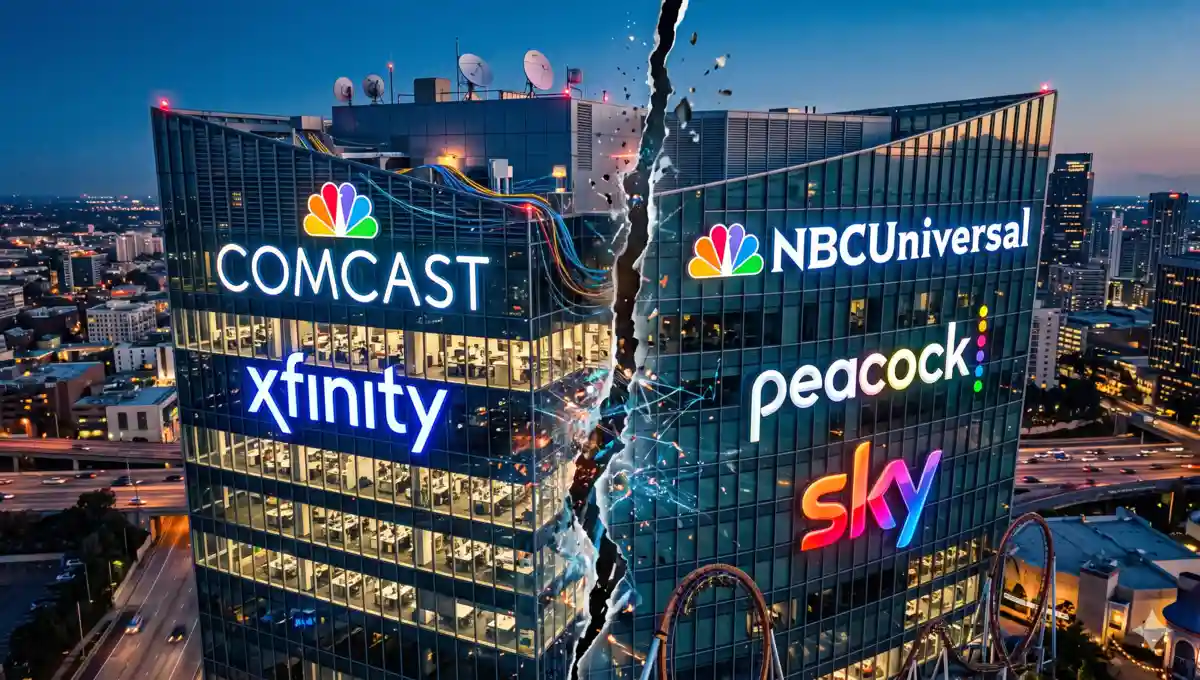
Comcast has announced one of the biggest restructurings in modern media, confirming plans to separate its media and entertainment businesses—including NBCUniversal, Peacock, Universal Studios, theme parks, and European broadcaster Sky—into a new publicly traded company.
The move effectively ends a strategy that began more than 15 years ago when Comcast acquired NBCUniversal to combine content creation with cable distribution. Instead, the company is embracing a different future: one where connectivity and entertainment operate independently. The transaction is expected to close within approximately one year, subject to regulatory and board approvals. Comcast shareholders will own shares in both companies, while Comcast plans to retain up to a 19.9% stake in the new NBCUniversal for up to one year before gradually reducing its ownership. Reuters, the Associated Press, and Comcast’s official announcements all confirmed these details.
But beyond the headlines lies a far bigger story.
Rather than simply splitting a company in two, Comcast is acknowledging that the traditional media business model no longer delivers the valuation investors want.
What Will Each Company Own?
After the transaction:
Comcast will primarily focus on:
- Broadband internet
- Xfinity services
- Wireless operations
- Business connectivity
- Enterprise communications
The new NBCUniversal company will include:
- NBC television
- Peacock streaming
- Universal Pictures
- Universal theme parks
- Telemundo
- Bravo
- Sky (Europe)
Mike Cavanagh will become CEO of NBCUniversal, while former Comcast CFO Michael Angelakis will return as CEO of Comcast. Brian Roberts will remain involved with both businesses. These leadership appointments were announced alongside the restructuring.
Why Comcast Is Making This Move Now
The official explanation is straightforward: each business can pursue its own strategy with greater flexibility.
However, several industry trends make the timing particularly significant.
1. Wall Street No Longer Rewards Conglomerates
One of the least discussed aspects of this announcement is how dramatically investor preferences have changed.
For years, companies believed owning both content and distribution created a competitive advantage.
Today’s market tells a different story.
Investors increasingly assign higher valuations to focused companies with simpler business models rather than diversified media conglomerates.
This helps explain why Comcast shares surged more than 20% in premarket trading immediately after the announcement. Investors appear to believe the individual businesses may ultimately be worth more separately than together.
2. Streaming Has Changed the Economics of Television
Traditional cable networks once generated enormous profits.
Today, the industry faces:
- Cord-cutting
- Slowing advertising growth
- Rising streaming costs
- Fierce competition from Netflix, Disney, Amazon and YouTube
Maintaining both a cable infrastructure business and a global entertainment company under one corporate umbrella has become increasingly difficult.
Separating them allows each management team to focus on different challenges rather than balancing conflicting priorities.
3. Comcast Is Returning to Its Strongest Business
Another overlooked angle is that Comcast’s most stable cash-generating asset is no longer television.
It is broadband.
Internet connectivity continues to produce predictable recurring revenue, while streaming and film production are becoming increasingly volatile.
The restructuring effectively transforms Comcast into a connectivity-first company instead of a hybrid telecom-media conglomerate.
That strategic clarity may prove attractive to long-term investors.
What Happens to Peacock?
Peacock remains one of the most interesting pieces of the transaction.
Unlike previous Comcast restructurings, Peacock stays with NBCUniversal rather than Comcast.
This matters because streaming success increasingly depends on combining:
- Film studios
- Television production
- Sports rights
- News
- Theme parks
- Consumer products
Keeping these assets together allows NBCUniversal to compete more effectively against companies such as Netflix and Disney.
Whether Peacock can become consistently profitable remains one of the biggest questions facing the new company.
The Sky Business Could Become More Valuable
Sky rarely receives as much attention in U.S. coverage, yet it may become one of the new company’s most valuable international assets.
Sky gives NBCUniversal:
- Millions of European subscribers
- Sports broadcasting rights
- International production capabilities
- Distribution across multiple European markets
As streaming growth slows in North America, international operations could become increasingly important.
Could NBCUniversal Become an Acquisition Target?
This remains speculative.
Comcast insists the new company is designed to succeed independently.
However, separating NBCUniversal creates a cleaner corporate structure that could make future strategic partnerships—or even acquisition discussions—easier than before.
Large technology firms, global media companies, or international investors may eventually view a standalone NBCUniversal as easier to evaluate than one embedded inside Comcast.
There is currently no announced sale process, and any future deal would depend on market conditions and regulatory approval.
What This Means for Shareholders
Existing Comcast shareholders are expected to receive shares in both companies after the spin-off.
In theory, investors will gain exposure to:
- A stable telecommunications and broadband business
- A global entertainment and streaming company
Markets often favor this structure because each business can be valued according to its own financial profile rather than as part of a diversified conglomerate.
The Bigger Industry Message
Perhaps the most important takeaway is what Comcast’s decision says about the future of media.
For decades, the industry’s dominant strategy was vertical integration—owning both content and distribution.
This announcement suggests the next era may prioritize specialization instead.
Media companies increasingly believe success comes from being exceptionally good at one business rather than adequate at several.
That shift could influence strategic decisions across Hollywood, telecommunications, and global entertainment for years to come.
Conclusion
Comcast’s decision to separate NBCUniversal and Sky marks far more than a corporate restructuring. It reflects a fundamental reassessment of how media companies create value in an era dominated by streaming, broadband connectivity, and changing investor expectations.
If the separation succeeds, Comcast could emerge as a stronger technology and connectivity company, while NBCUniversal gains the freedom to compete as a dedicated global entertainment powerhouse.
For investors, competitors, and consumers alike, this may become one of the defining media transactions of the decade—not simply because of the companies involved, but because of what it signals about where the industry is heading.

Mohammed Nooruddin is a finance and technology expert with a background in journalism. He previously worked as a reporter with 4TV Hyderabad and now contributes to Raftaar e Deccan, covering FinTech, cyber crime, and artificial intelligence.