

Mohammed Naseer Giyas
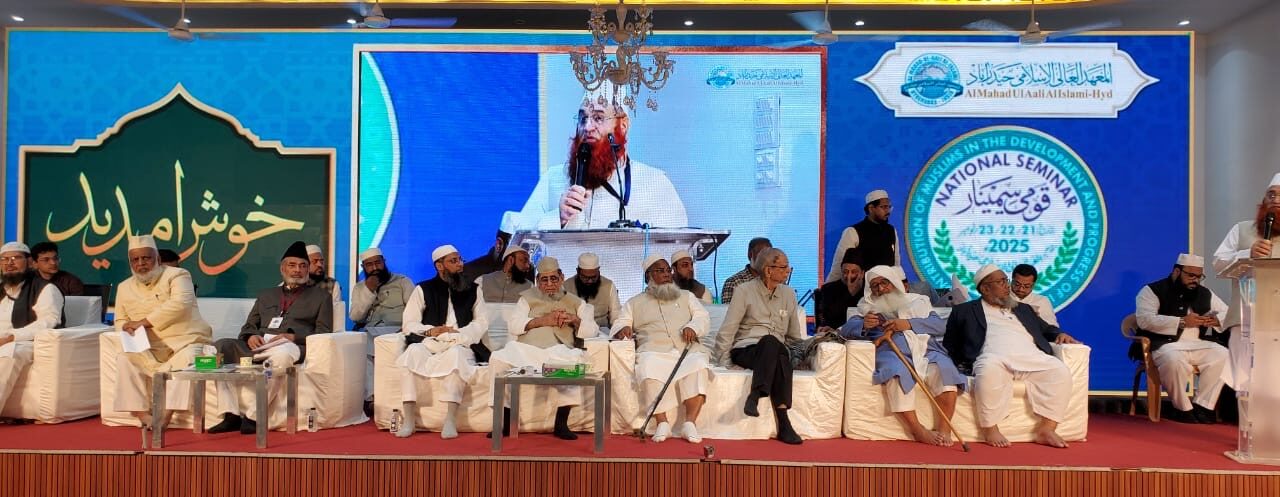
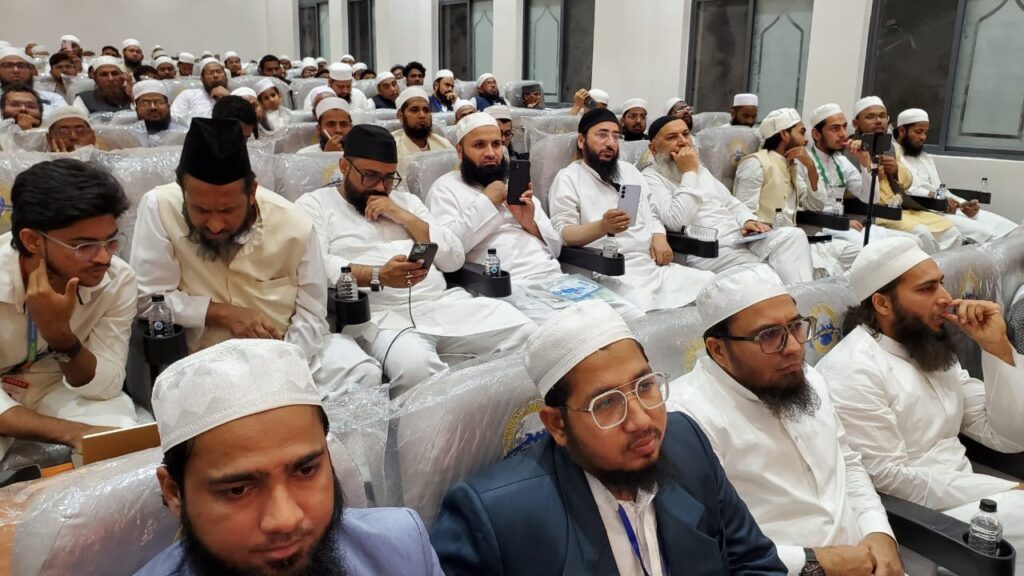
Hyderabad, November 21: Scholars, community leaders, academics and former civil servants stressed the need to protect India’s real history and defend the record of Muslim contribution in the country’s growth. They spoke at the opening day of the three-day national seminar titled “The contribution of Muslims in the Development and Progress of India”. The event took place at the newly built auditorium Dar al Tarbiya of Al Mahad Al Aali Al Islami, Hyderabad. The first session was chaired by Maulana Khalid Saifullah Rahmani, President of the All India Muslim Personal Law Board.
Speakers said the country’s progress is linked to the sacrifices of Muslim rulers, scholars, freedom fighters, workers and ordinary citizens. They warned that organised attempts are being made to hide this role, distort historical facts and spread fear among youth.
Speakers Raise Concern Over Distortion of History
Addressing the gathering, several scholars said the nation’s past holds clear evidence of Muslim service in every sector. They said the country’s heritage, institutions and culture reflect this long history. They also said certain groups aim to remove this record to weaken social unity.
Participants noted the following concerns: Textbooks no longer mention major Muslim contributions. Films project fabricated events. Media spreads selective narratives. Hate campaigns target Muslim traders and businessmen. Youth are pushed away from real historical knowledge. Speakers urged the community to provide accurate material to students so they understand the country’s shared past. They said this is essential for peace, unity and national strength.
Noted academic Dr Ram Puniyani delivered a strong address. He said Hindus and Muslims launched the 1857 freedom struggle together, which caused fear among the British. He reminded the audience that the British responded by spreading division. He said the same pattern is visible today in the actions of some groups. Dr Puniyani said riots do not occur without hate. He said people remain united when they share respect. He warned that hate is being filled in people’s minds through false narratives.
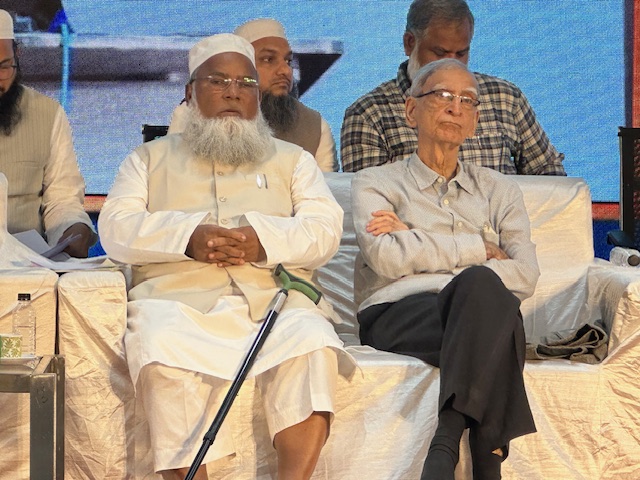
Dr Ram Puniyani Calls Out Hate Politics
In his keynote address, Maulana Khalid Saifullah Rahmani said Muslims have always treated this country as their homeland. He said they gave their time, skills and wealth to strengthen its foundation.
He gave detailed examples:
Muslim rulers built monuments like Taj Mahal, Qutub Minar, Delhi’s Jama Masjid and Hyderabad’s Makkah Masjid.They developed gardens such as Shalimar and Nishat.They built cities from Bengal to present-day Afghanistan.They created thousands of inns, hospitals and educational institutions.They planted new fruit and flower varieties from Central Asia.They established large libraries and supported science and learning.
They built the 1500-kilometer long road from Sonargaon to Afghanistan.He said these works created economic strength and shaped India’s cultural identity. Maulana Rahmani said India’s growth in modern industry also includes major contributions from Muslims. He named Azim Premji of Wipro, Yusuf Khwaja of a leading pharmaceutical firm, MA Yusuff Ali of Lulu Group and Dr Habib Khora who set up hospitals and research institutions. He said these examples show strong involvement of Muslims in entrepreneurship and job creation.He noted that India’s missile program has the imprint of Dr APJ Abdul Kalam, who served the country with dedication.
Muslim Impact on Law, Society and Constitution
Maulana Rahmani also said Muslim scholars helped revive women’s rights and end harmful practices such as sati. He stated that several features in the Indian Constitution reflect values found in the Qur’an, including justice, dignity and welfare. He said these principles counter ancient discriminatory practices. He expressed concern about recent efforts to paint Muslims as oppressors. He said false history and propaganda hide the country’s shared achievements. He said the current environment demands calm and honest work. He clarified that the seminar does not aim to attack any group. Its purpose is to present facts and defend truth.
Former IPS Officer Highlights Structural Exclusion
Former IPS officer Abdul Rahman addressed the session and focused on the position of Muslims in bureaucracy. He said bureaucracy is the backbone of any government, yet Muslims form only four percent. He asked why Muslim literacy levels remain low compared to other communities.
He said Muslim civil servants rarely speak about the injustice they witness. He said senior officers also avoid raising concerns. He gave two examples. Since independence, only one Muslim has served as IB Chief and only one has served as Cabinet Secretary. He said this shows deep structural exclusion.
Papers Presented on Industry, Science and Agriculture
Researchers and scholars presented papers across two sessions. They covered:
Role of Muslims in industry and manufacturing.
Agricultural and irrigation systems during Muslim rule.
Trade and industrial development in Kashmir led by Muslim communities.
Architectural innovations introduced by Indian Muslims.
Underground water channels and engineering achievements.
Presentations were delivered by Maulana Ashraf Abbas Qasmi, Maulana Muhammad Nafi Arfi, Mufti Nazir Ahmad of Kashmir, Dr Iqbal Ahmad Engineer and Dr Saud Alam Qasmi. The sessions were moderated by Maulana Umar Abideen Qasmi Madani.
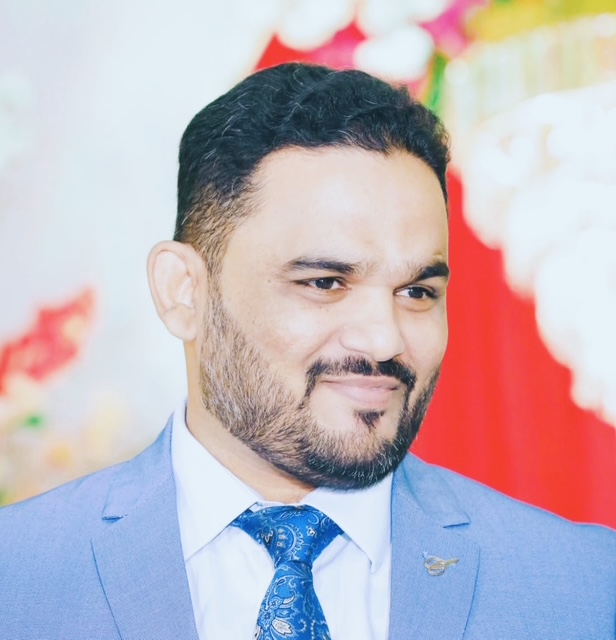
Mohammed Naseer Giyas is a multi-media and bilingual journalist with over 20 years of experience across print, digital, and television media. Founder of Raftaar-e-Deccan, he is an alumnus of IVLP, Thomson Reuters Foundation, and ICFJ, and has worked with leading English and Urdu news organisations.