


New Delhi:10 December Posted on 8:35 PM
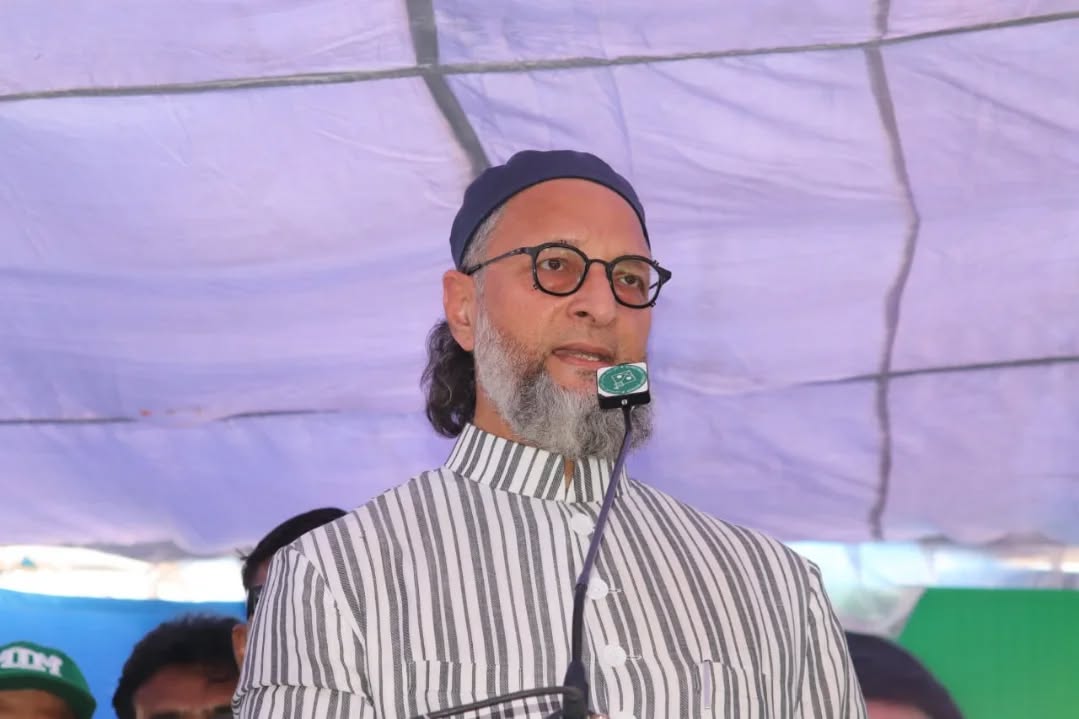
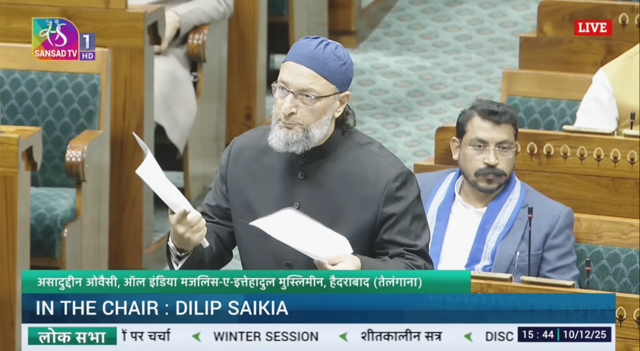
AIMIM president and Hyderabad MP Asaduddin Owaisi on Wednesday opposed the Election Commission’s special Intensive Revision related to voter rolls. He said the order violates parliamentary law, contradicts Supreme Court directions, and selectively targets citizens on the basis of religion.
Speaking in Lok Sabha, Owaisi said the Representation of the People Act 1950 and Electoral Rules 1960 already define how names are included in voter rolls. Inclusion is based on self-declaration of citizenship supported by one of six documents listed in Form 6. This process is passed by Parliament and has legal validity.
He referred to a Supreme Court judgment in the Lal Babu Hussein case that held once a person is added to the electoral roll, there is a presumption of citizenship. Deletion can only follow an inquiry, written reasons, and an opportunity for personal hearing.
According to Owaisi, the Election Commission has reversed this principle by asking voters to prove citizenship again. He said voters from the 2025 rolls are being asked to submit documents without any reasoned doubt recorded in advance. He argued that the Commission has no legal power to assess citizenship because that function belongs to the Ministry of Home Affairs under citizenship and foreigner rules.
Owaisi said the Commission issued notices to lakhs of voters asking them to appear with documents. Names were deleted without written orders placed in the public domain. He said 3.66 lakh names were removed from the rolls after draft publication.
He noted that the government issued an Immigration and Foreigners Exemption Order on the same day the draft rolls were released, exempting several groups from foreigner proceedings. These include Nepalese, Bhutanese, Tibetans, Sri Lankan Tamils and non-Muslims from Afghanistan, Pakistan and Bangladesh. Owaisi said the timing indicates selective protection and weakens the credibility of the exercise.
He called the verification a “backdoor NRC” designed to create fear and disenfranchise targeted communities. He warned that the right to vote is the foundation of the Constitution and must not be weakened.
Owaisi said only four percent of current Lok Sabha members are Muslims and major national parties have not ensured equal representation. He argued that exclusion from elected bodies will damage social equality even when voters participate in every election.
Owaisi also said financial influence distorts representation. He cited figures that show a large share of recent electoral donations went to the ruling party. He urged national parties to consider a mixed parliamentary model, similar to Germany, where voters cast one vote for a local candidate and another for a political party to balance representation.
He cautioned against political delimitation that reduces the voting power of marginalized areas. He said fair delimitation protects democratic choice and prevents selective advantage.
Owaisi requested that the age of contesting elections be reduced to reflect India’s young population. He proposed 20 years for Assembly and Lok Sabha elections and 25 years for Rajya Sabha.
He asked Parliament to build consensus and convert the right to vote into a fundamental right to protect citizens from administrative exclusion.
Mohammed Naseer Giyas is a multi-media and bilingual journalist with over 20 years of experience across print, digital, and television media. Founder of Raftaar-e-Deccan, he is an alumnus of IVLP, Thomson Reuters Foundation, and ICFJ, and has worked with leading English and Urdu news organisations.